Playing Table Foosball in Australia – All There is to Know
The history of foosball, what it's called around the world, the key rules, and answers to the most common questions about table football.
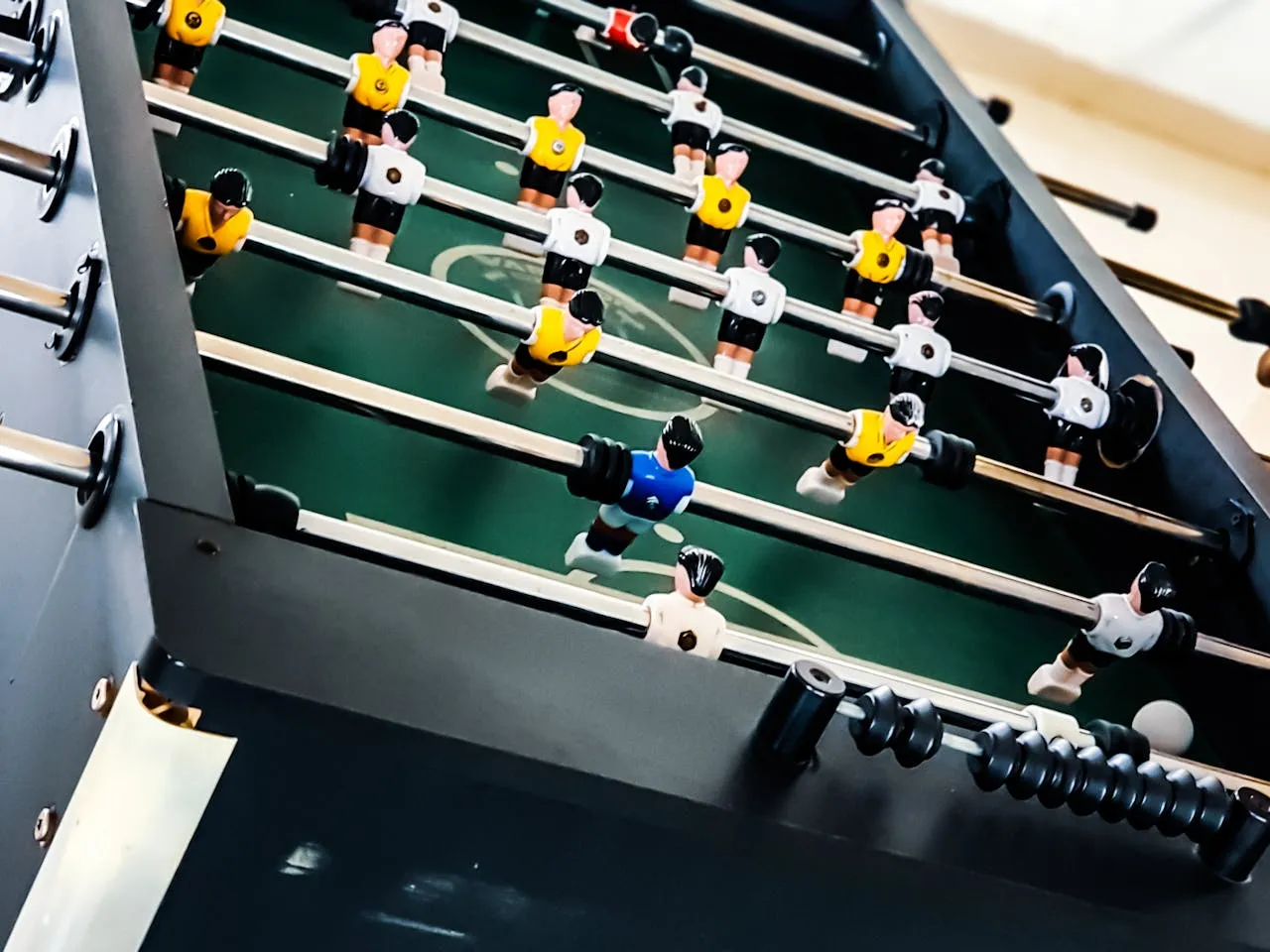
Foosball is an exciting tabletop version of soccer and a well-loved family pastime. The aim is to score by kicking the ball into your opponent’s goal, using rods that turn and slide the foosball men. Think of it as a compact soccer match played on a table, with spinning rods and mini-players instead of a field and a team.
It’s a global phenomenon, and here’s everything you need to know about it.
The Game of Foosball
There are several competing theories about where foosball came from. The best known is that Harold Searles Thornton filed the first known table soccer patent. The story goes that he came up with the idea in the 1920s from a box of matches, laying matchsticks across the top of the box. Those sticks became the turning rods of the first foosball prototype.
Today foosball is played in hundreds of countries around the world. Over time it grew from a parlour and arcade game into an organised sport, with leagues, tournament rules and competitive seasons.
Foosball goes by the following names globally:
- Footzy
- Table football
- Bar football
- Baby-foot
- Fussball or Fußball in Germany
- Kicker in Germany and Russia
- Calcio Balilla and Biliardino in Italy
- Csocsó in Hungary
- Fla-flu, Pebolim or Totó in Brazilian regions
- Futbolín in Spain
- Taca Taca in Chile
- Metegol in Argentina
- Futbolín or Fulbito de Mesa in Perú
- Futbolito or Canchitas in other Latin American countries
- Djaga in Bulgaria
- Langirt in Turkey
- Matraquilhos in Portugal
- Tafelvoetbal in the Netherlands
- Gitoni in Canada
- Ta-Ta Box in South Africa
- Piłkarzyki in Poland
- Football Dasti in Persia
The rules, table dimensions and prices of table soccer vary from country to country.
Foosball is loved around the world because its design is attractive and its rules are simple. It’s an excellent pastime for children and adults, and it’s never too late to start. If you’re thinking of buying a table, our best foosball tables guide compares brands, models and Australian retailers.
The basic rules
- Players: two in singles or four in doubles.
- Kick-off: the ball is served into the centre, and play continues until someone scores.
- Scoring: a goal counts when the ball enters the goal, even if it bounces back out. Games are usually played to five or ten goals.
- No spinning: rotating a rod 360° before or after hitting the ball is illegal (see the FAQ below).
- No jarring: bumping or shaking the table to move the ball is a foul in competitive play.
Frequently Asked Questions (FAQs)
Here are some of the most commonly asked questions about table foosball:
Who invented the foosball table?
Harold Searles Thornton. The idea of table soccer can’t be credited to a single person or country, but Thornton holds the first recorded patent. Several tabletop games were patented as early as 1890, but Thornton was the first to patent table football. He was granted UK Patent No. 205,991, dated 14 October 1921 and accepted on 1 November 1923, for an “Apparatus for Playing a Game of Table Football”. He was inspired by a Tottenham Hotspur FC match that he wanted to recreate at home, and used a matchbox as the model for his design.
His uncle, Louis Thornton, brought the game to the United States after visiting Harold. He patented table football there in 1927, but it didn’t catch on at the time, and the patent eventually expired.
Why is foosball called foosball?
“Foosball” is the American version of the German word Fußball, or Fussball. Lawrence Patterson reintroduced the game to the United States after being stationed with the US military in West Germany in the early 1960s, where it was already popular.
Where is foosball most popular?
Europe and the United States. According to Retroonly, foosball is most popular in Europe and America. At a professional level, the top five countries in the International Table Soccer Federation (ITSF) 2021 rankings were Germany, France, Switzerland, the United States and Austria.
How much does a foosball table cost?
Table soccer comes in many shapes and sizes, from mini and coffee-table versions to tables small enough for children. Full-size tables vary in dimensions depending on the country standard. In Australia, entry-level 4ft and 5ft tables typically cost around $200–$500, mid-range tables $500–$1,500, and tournament-grade tables $1,500 or more.
What foosball table is used in tournaments?
A tournament table is around 29–30 inches (73.7–76.2 cm) wide, 54–56 inches (137.2–142.2 cm) long and 34–36 inches (86.4–91.4 cm) high. Tables recognised by the ITSF have included Bonzini (France), Garlando and Roberto Sport (Italy), Leonhart (Germany) and Tornado (USA). Check the ITSF website for the current list of official tables.
How many players are there in foosball?
Up to four people can play a game of foosball, using both sides of the table. Two people compete in a singles match, and two pairs play in a doubles match.
Is it illegal to spin in foosball?
Yes. Spinning the rod is illegal in foosball. A spin is when you rotate the rod through 360 degrees before or after hitting the ball.
If the ball is moved by an illegal spin:
- If it goes into the opponent’s goal, the goal doesn’t count. The ball is declared dead and put back into play between the goal and the nearest two-man rod.
- If it goes into the spinner’s own goal, it counts as a point against them.
There are exceptions where spinning is legal:
- Spinning a rod away from the ball.
- An ungrasped rod rotating because the ball hit one of its figures.
Table soccer is a lot of fun, and knowing the rules before you buy helps you pick a table that suits the way you’ll play.